Carmen Yulin Cruz Soto
Former Mayor of San Juan, Puerto Rico
November 3, 2025
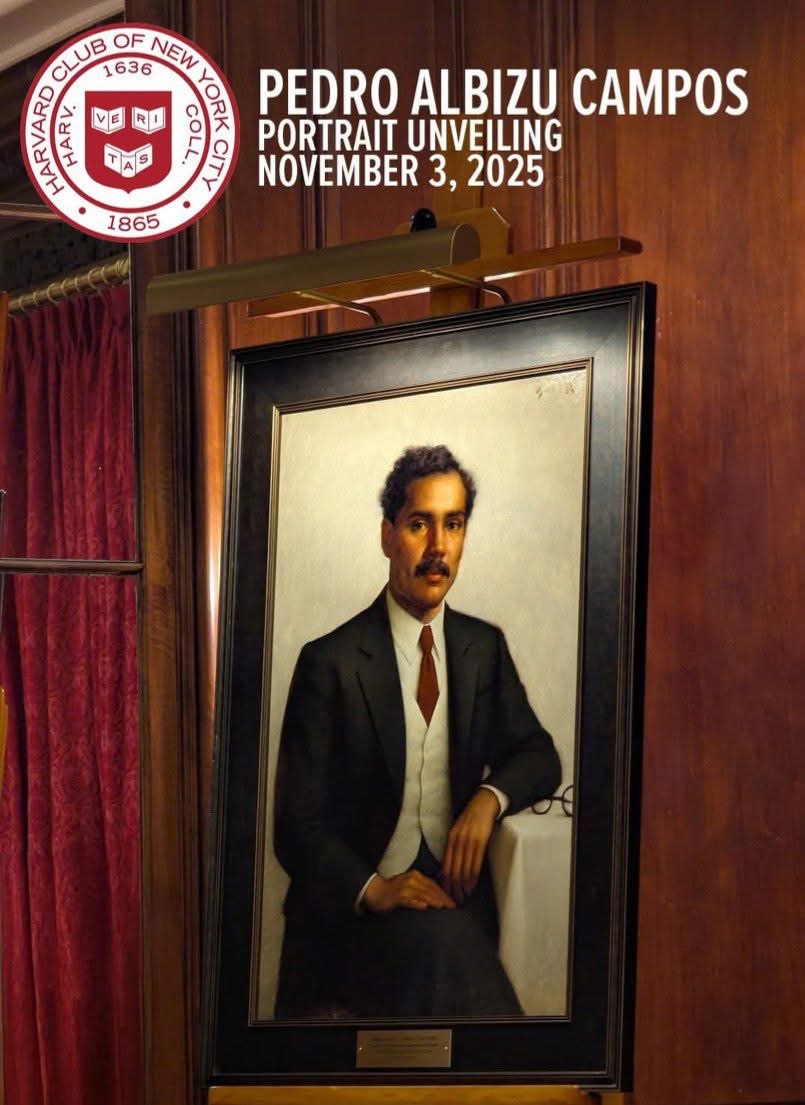
Closing keynote at the unveiling of Don Pedro Albizu Campos’ Portrait,
Harvard Alumni Club New York City, New York
It is attributed to George Orwell, a statement that says that in times of deceit, telling the truth is a revolutionary act. Well, today, I’m here to begin a revolution. And I have the distinct privilege of not having to be politically correct. Something that got me into a lot of trouble many times, but that keeps me sleeping very well, each and every night. I stand before you as the great-granddaughter of a sugar cane plantation worker on one side, from the town of Guánica, Puerto Rico, where the United States invaded the island nation of Puerto Rico for the second time.

Now, truth sometimes hurts. It doesn’t mean that I do not admire the principles by which this country, the United States, was created. I admire them so much, I want them for my country, Puerto Rico. My creator endows me with certain inalienable rights, among which are life, liberty, and the pursuit of happiness. And while we are here today, honoring Don Pedro Albizu Campos. And notice how Baba said, Don Pedro Albizu Campos, which is a distinction that Puerto Ricans give to worthy people. No todo el mundo es Don.
So on one side of my family, there they were extreme poverty. I mean, I mean, no shoes, no food, no future. And I also stand before you as a great-granddaughter of a coffee plantation owner from Lares, Puerto Rico. You can imagine the fights between my parents were wonderful. One from the town that held a small revolution, small in time, but not in spirit, Lares, Puerto Rico. And here we are. When they fought at the dinner table, one of them would say to the other, “You who are from that town that couldn’t even make a revolution work. And my mother would say, “And you, from that town that couldn’t even defend our motherland.” That was some tough, some tough decisions and some tough questions.
I want to discuss four aspects of Don Pedro Albizu Campos with you. And one, “Baba” already touched a little bit upon, but it was his ability to understand himself as part of a greater environment. His ability to understand, as Fanny Lou May would say, “no one is free until everyone is free,” which is why he was very much in tune with the Irish Revolutionary movement. This is why he was closely aligned with other revolutionary movements throughout Latin America. You see, if COVID has taught us something, is that what you do impacts me and what I do impacts you. So if a child is torn from the hands, or from the arms, of his or her mother, down in a border that some of us may never have seen, it is as if my own child, Marina, would have been torn from my arms. If somebody goes into a school, because the people that are in charge of saving our children’s lives are more interested in the money that the NRA can give them, and don’t pass sensible control laws and they get killed, that child could have been my child. Hurricane Maria didn’t ask anyone who they voted for before they ripped everything that we have. Today, because of the incompetence and the neglect of a government that thought our lives could be expendable, 3,000 Puerto Ricans plus did not open their eyes. They died out of neglect simply because we are colonial subjects. And there are still people in Puerto Rico who tomorrow will say, Oh my God, what is Yulin doing over there, That communist.
Why are we saying that Pedro Albizu Campos should have a portrait at the Harvard Club, albeit it being independent from Harvard University? But those people are the same ones who revere George Washington and Nelson Mandela. Those are the same people who say that it was okay for the 13 colonies to rise against the conqueror. Now, what a hypocrisy, right? But you see, that is what colonialism does to you. It confuses you. It makes you observe and admire that which you are not. I call it, and I think only Puerto Ricans will understand this, the complex of “el coquí que quiere ser sapo.” The coqui that wants to be a frog. It is, it is a structural offensive to create an identity crisis, which will strip us or pretend to strip us from that identity that Don Pedro Albizu Campos exemplified in everything he did. For the life of me, I cannot understand why a nation that began by breaking up and understanding that being colonial subjects was beneath them would still have colonial subjects. So one of the things that Don Pedro Albizu Campos teaches us, and one other thing that is reflected so beautifully, Gustavo (Gustavo Ramos, artist), thank you, thank you. In seeing the dignity, the resistance, and the advocacy of Don Pedro Albizu Campos, we can see ourselves. Most people don’t know this about me, but I am a deeply religious person; deeply religious person. There’s not one day that goes by that I don’t say, perhaps at least one part of the rosary, and they say, “God, you’re almighty, you finish it for me. I have much to do”.

However, for Don Pedro Albizu Campos, the fight for freedom and justice was not merely a political struggle. It was a moral imperative. The ethical imperative that many of you felt in New York City at the time of the hurricane to come to our aid, because the first people that went to someone to say, “here we are”, seven days after Hurricane Maria devastated Puerto Rico; I’m sorry, I’m going to correct myself nine days after Hurricane Maria devastated, Puerto Rico, was a contingent led by Melissa Mark Viverito and sent because of her insistence by then mayor Bill de Blasio, who stayed with us in San Juan for the next six months. Nobody had to fill out any paperwork. I didn’t even call Bill De Blasio. He heard us, he saw us, and he did what he had to do. That’s exactly what Don Pedro Albizu Campos did.We call people who are ahead of their time, those who dissent. But the minute we call them that, we’re saying that there is a norm and that they dissent from that norm. So it makes the norm sound as if it is a good thing. They don’t dissent; they just answer to a higher power. They respond to the dictates of their conscience. They show every one of us that in order to move forward and push forward, we each have to answer to our conscience. So Yulin, well, there are people in this country right now that would tell you that they’re responding to their conscience. But some consciences unite, while others divide. Some build, some destroy. Some push agendas forward, which are all-encompassing and give us space; others don’t.
Don Pedro Albizu Campos was never afraid to speak up. And let me tell you a little story about when I was about six or seven years old. I’m about five well, I’m 4 feet 11 and a half. That half inch is crucial. My grandmother was 4, 11. When I was about six or seven years old, I used to be bullied in the playground at school. And one day, Alberto Ferreras, who produced the Habla series for more than 20 years on HBO, invited me and Edgardo Miranda to be part of that wonderful project. So Alberto, I’m sorry, you’re going to hear this again. One day, my grandmother had a little bit of a cut lip and a little bit of a nosebleed, and she said, ‘¿que pasó?” and you know, when your grandma said “¿que pasó?” you’re in trouble. And I said, no, you know, they’re calling bullying now. But I said, no, they pushed me on the playground ‘cause I’m little. And she said, “Did you start the fight?” And I said, no. “Did you finish the fight?” And then my lips started doing that little thing that, you know, when you want to cry, but you can’t. And, you know, you don’t want your Puerto Rican grandmother to whoop your ass, right? Never, never. So she said, I said, Well, I’ll tell you what you’re going to do. Now, these are the late ’60s. I do not ascribe to violence. I am telling you what she told me to do. I see the average age here, you’ll understand. Remember those lunch boxes we used to have, which were made of metal with a thick thermos that would often break. So she said, this is what you’re going to do. The next time that happens, you’re going to take your lunchbox and you’re going to hit them as hard as you can. And you’re going to run as fast as you can; and you’re going to scream as loud as you can. Because if he gets to you, he’s going to pummel you. He is a lot higher. So it happened again, so I did what she told me. They called her to school. I’m sitting outside, you know, with a big smile. And she said, “Did you start the fight?” And I said, “No, but I finished it.” We go in and the teacher starts on me. We don’t know what’s happened. She’s such a good student, she’s such a calm person. My boyfriend would say calm, they’re describing somebody else, not her. I don’t know what is wrong, you know, what happened? And my grandmother stood up 4 feet 11 inches and said, You know what, this is interesting. While she was getting pummeled, nobody did anything. But now she stands up and defends herself, and then now she’s the bad guy. So tell me, well why she get suspended, I don’t even know how many days. My grandmother said, Pick up your things, I’m taking you for ice cream, because you have to know you have every right to defend yourself. But then, while we were in the car, she told me something that was even deeper, and that goes to your question of why he did what he did. She said, “You have every right to defend yourself, but you have a responsibility to defend others.” So you see, he attended Harvard, received an education of privilege, but he knew he had a responsibility to others, to his motherland, and to his nation.
I am not a colonial subject. I am a Puerto Rican national with American citizenship. That is different than being an American. And I don’t say that to be disrespectful. I say that to put into context, now I understand that’s not the way all Puerto Ricans feel. However, we must respect the right of others to pursue the future path for Puerto Rico they desire. We must do it on a process of self-determination which Don Pedro Albizu Campos really believed in; and we must also do it with respect to other people’s visions. So what is my vision? I think you all can figure it out by now. But I’m going to do something that I’ve never done in public before. The right to be free is an unalienable right. Freedom and independence don’t have to be recognized. It is a right of the Puerto Rican people to be free and decide their future. And in that future is becoming a state of the United States, under the right and true conditions, not under a Puerto Rican statehood that does not exist anywhere else, so be it. And if it is, what I favor, which is independence in a compact with the United States, so be it. And if it is independence, so be it. But Don Pedro taught us and continues to teach us, and thanks to the courage and wisdom, if I were in church, they would say “es justo y necesario” cómo se traduce justo. It’s right and just; just and necessary. Erica (Gónzalez) said, “Viva Puerto Rico Libre.” I told you at the beginning that some Puerto Ricans revered Don Pedro Albizu Campos, while others hate him. Luis, I am in awe of your ability tonight to put his life in perspective. And, you know, Luis and I in other topics would be at the extreme sides of the room. But on the acknowledgement of the legacy of a man who, 160 years later after his birth, we’re talking about him today.
And 61 years after his death, we’re talking about him today. And not only are we talking about him, but we are memorializing him. And look at these walls, this is a great institution. And again, I’m not a lawyer, but I will do Amaka the favor of saying, reminding you again that this is not the same thing as Harvard. And great institutions are there for critical thinking. Civil discourse has to be on the table. And that doesn’t mean I have to agree with you. I do not agree. I do not agree right now, today, with the use of force to get independence for Puerto Rico. That is a major difference between Don Pedro and myself; but I cannot condemn him without condemning other men, Blanca Canales, you know, other women, Lolita Lebron who said, “I didn’t come here to kill, I came here to die. That’s a difference. I didn’t come here to kill, I came here to die.”
So it is that we look at figures like Don Pedro Albizu Campos from a romantic point of view. It is that we understand that they transcend their time. It is that we understand that it is their struggle against structural racism and colonialism. Indulge me for maybe two more minutes. What I’m going to say, I say with deep sorrow and and sadness. But one of the things that colonialism tries to do is to strip you of your symbols. We are taught that the big bull is the American bull. Y el Josco can’t deal with that anymore, and just decides to kill himself. Amaka gave you homework, this is another homework. Look it up, if you’ve never heard of it, Abelardo Diaz Alfaro. We are taught that the large egg and the white egg is the American egg. And I’m going to say this to you, and you please excuse me if I get a little emotional, because it just upsets me to the core. But then we are taught that the large cockroach is the Puerto Rican cockroach, and we say , no eso es una cucara Hita americana, the small one. Agent Orange was tried in Puerto Rico. Women were massively sterilized in the 40s and ’50s, with a memo that said, “there are too many uneducated Black Puerto Ricans, they must be stopped.” Now, that does not mean that every interaction between the Puerto Rican people and the American people is a bad interaction. There are 6 million Puerto Ricans living in the United States and 3.2 living in Puerto Rico. And we cannot negate that at a point in time, economic prosperity boomed. But that does not negate that the contraceptive pill was tried in Puerto Rico 20 times stronger than it ended up being, and that still, women of my generation are feeling the result of those tests. There is a saying in Spanish, de buenas intenciones esta lleno el camino al infierno, of good deeds or good intentions, the path to hell is paved.
When we speak about freedom, we do not do it because of an anti-American sentiment. We do it because, as Americans, we, as Puerto Ricans, are entitled to the same thing. I’ll finish with this. Yesterday, I flew back from Puerto Rico. My mother has Alzheimer’s. So sometimes she’s there and sometimes she isn’t. She asked me where I was going. I told her to Nueva Yol, and she said, what was I going to do?” And I said, “Well, I’m going to go to the unveiling of a portrait of Tom Pedro Albizu Campos. And she lit up. And she said, you know, your grandfather used to beat me up at least once a year. And I said, “At least once a year.” And she said, “Yeah, because on September 23rd, which is El Grito de Lares, I used to skip school to go see Don Pedro Albizu Campos speak. And she said, but not only, you know, hear him speak, I loved to walk down the main road – bendito as if Lares has more than one main road but still. I love to go down the main road with him and see him shaking hands and kissing people. And I said, “Mom, and why did you go listen to him?? And she said, because we loved him. And, Mom, why did you love him? And she took her fist, and she said, because he embodied the dignity of the Puerto Rican nation. I’m sorry to tell the distinguished members of the Harvard Club in New York, which is a separate entity in from Harvard University and Gustavo, that that portrait is not of Don Pedro Albizu Campos. That portrait carries with it all of the dignity of the Puerto Rican people, no matter the ideology that they profess. That portrait means endurance, perseverance, faith, that portrait makes us understand that we are one Puerto Rican nation divided by an ocean. That portrait makes us understand that as long as they have us fighting amongst us, they’re stronger and we are weaker. I once told a gentleman, no, that’s not the word for him. I once told, a man, “This is not about politics, Mr. President. This is about saving lives.” That portrait is not about Don Pedro Albizu Campos. It is about the hopes, the sorrows, the fights, and the path forward of an entire nation who, even though it has been colonized twice, it has endured and it has persevered. I will make a test before my last remarks. Yo soy Boricua. It doesn’t matter where we are. Just say that and you’ll find us. It is important that we understand this; pa que tu lo sepas means just so that you know, but it really is like in your face. You know, I’m Puerto Rican in your face.
Our lives are not expendable. We didn’t have to die the way we did after Hurricane Maria. And those that were entrusted with a responsibility, because when you put boots on the ground, you have a responsibility. To not come to our aid to do their job, were incapable or were unable or did not want to. But it’s also that portrait also means that whatever Puerto Rico becomes from now on, it is on us. We have to develop our economy. We have to build soberanía alimentaria. We have to develop the kind of work ethic that will allow us to sustain ourselves.
We cannot continue to just look up north for the solution to our problems. With great power comes great responsibility, right? Spider-Man. With liberation and freedom also comes, great responsibility. Which is why I have this little pin over here from the only Puerto Rican superhero La Borinqueña, of course, she’s an Afro-Latino woman. Edgardo Miranda, the creator, is here. Let’s do a little less complaining, a little less talking, and a little more action. Yeah, let’s understand that it’s on us. On us. Eleanor Roosevelt once said, “No one can make you feel inferior without your consent.” Well, that portrait says, we don’t consent. My mother asked me to say something on her behalf today. And for the first time ever, I will echo her words on my behalf. I would like to thank Amaka and everyone at the Harvard New York Club, which, as we know, is not affiliated with Harvard. But I want to tell you from the great-granddaughter of a sugar cane plantation worker, and the daughter of a woman from Lares, Puerto Rico. And from a 62-year-old woman, I know I don’t look 62. Qué bien me veo, ¿verdad? In the words of an old Negro hymn that I hope the day comes, where not only does my mother and myself say Viva Puerto Rico libre, but that we can say free at last, free at last, thank God we’re free at last. Muchas bendiciones y muchas gracias.###