
Text and art by Ramón López
“The most cherished entertainment for these Islanders is the dance; they hold them for no other reason than to pass the time, and they are rarely absent from one house or another. Whoever hosts the dance invites their comrades, spreads word across the territory, and hundreds come from elsewhere, even if they were not personally invited.”
— Geographic, Civil, and Political History of the Island of San Juan Bautista de Puerto Rico, Fray Iñigo Abbad y Lasierra, 1782
Tito arrived at a quarter to seven and found that the crowd had yet to gather. The bomba dance was scheduled for seven, and little publicity was made beyond spreading the word and inviting familiar faces. The Chicago summer heat was heavy in the air.
La Casita de Don Pedro gleamed beautifully, its balcony freshly painted, the garden weeded, and the star-shaped planter circling the Albizu statue filled with miramelindas, marigolds, chrysanthemums, cilantro, and parsley. Students from the Albizu Campos school had taken charge of the upkeep, and Ricky Salgado coordinated the beautification, repainting the iron flag on the gate and securing hoses and water from the neighbors to tend the plants. Brunilda, the neighbor who so dutifully watches over the Casita to keep strangers away when it’s left unattended, outdid herself: she hung a massive flag stitched together from scraps of fabric from her window and displayed her handcrafted Puerto Rican-themed creations for all to see. The day before, she had gifted us a black doll dressed in the Puerto Rican flag design and two straw hats decorated with roosters, coquí frogs, seashells, dominoes, and small algarrobo roosters, which we placed atop the little table of our handmade enea-grass and native wood furniture crafted by the Villalobos family of Ciales.
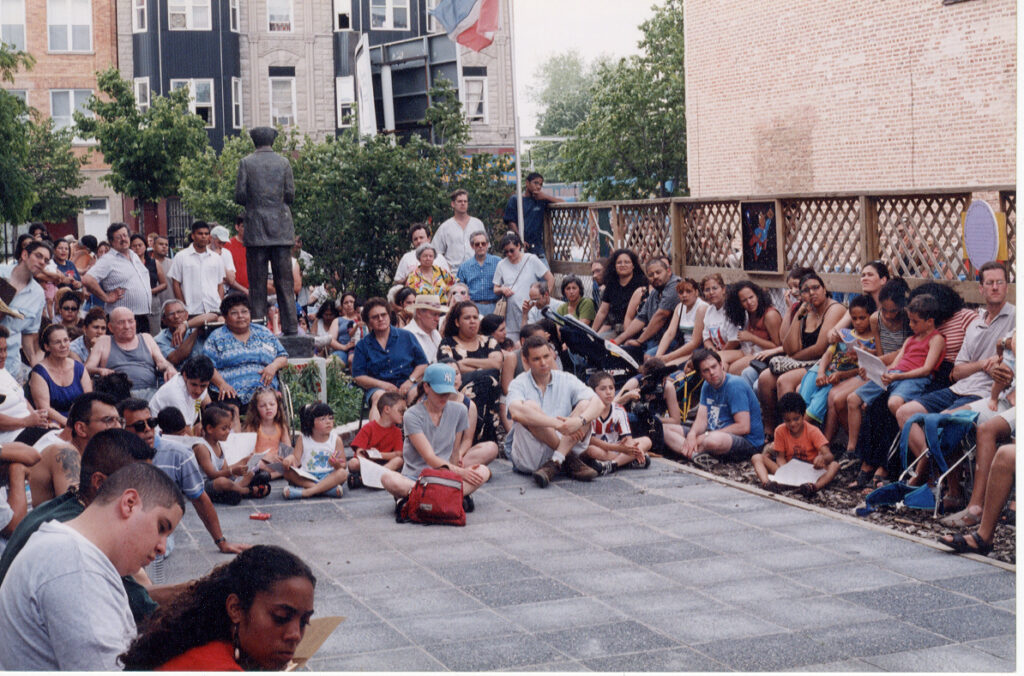
Taking advantage of the empty space, Tito crossed the street for a snack at Bodega Borinquen—under new management but still displaying its showcase of alcapurrias, rellenos, morcillas, fried meats, and boiled green bananas, not to mention all the Puerto Rican products without which no neighborhood bodega earns its name. The Borikén bakery next door was already closed. When he returned, people had begun to arrive. The girls who took weekly bomba and plena classes at the Casita were dressed and ready, and Ángel the drummer-dancer had come with his whole family, which, like Tito’s, was a Puerto Rican-Mexican mix with a strong Puerto Rican cultural pull. As they pulled out the drums and set up the borrowed sound equipment from Aspira, the place filled up with friends and visitors, soon occupying every bench and seat. When the time came to begin, I addressed the crowd with three points: we were happy they were there; we thanked everyone who had worked to make the event possible; and we dedicated the bomba dance to the people of Vieques and their struggle against the U.S. Navy.
These bomba dances bring together drummers, dancers, and singers from across the city, alongside apprentices, neighbors, and guests. People came from groups like Yubá, Africaribe, and Bembeteo, and with them, the dance began. The chorus took their places at the balcony microphones, and the drummers pulled the Casita’s long bench outside and set up with three bombas, cuás, and a maraca. In the crowd were our neighborhood friends, mingling with curious onlookers drawn by the sound of drums echoing from afar.
In nearby Humboldt Park, the third night of the Puerto Rican patron saint festivities was underway, dedicated to San Juan Bautista, and the streets were thick with boricuas—most decked in flags, shirts, hats, and an endless array of tricolor trinkets sold en masse for people to loudly announce their Puerto Rican identity. There, the commercialized fun—rides, foods, music, souvenirs—roared on, while hundreds of watchful, hostile police officers loomed, ready to quash any overzealous revelry. There, too, the second-best-selling flag was not the U.S. flag, but the Lares flag—one of those spontaneous flashes of popular wisdom that light up collective consciousness.

“The mix of whites, mulattos, and free blacks formed a most original group: the men in cotton pants and shirts, the women in white dresses and long gold necklaces, all with colored scarves and round, ribboned hats, dancing African and Creole dances to the sound of the guitar and the little drum commonly called the bomba.”
— Journey to the Island of Puerto Rico, André Pierre Ledrú, 1797
Back at the Casita, the bomba dance flourished in a cheerful, peaceful atmosphere, helped by the standing rule: no alcohol in a space filled with children. The dancers—many in jeans and sneakers—shared skirts to take their turn challenging the drummers. Outside the gate, more neighbors gathered, gradually losing their shyness and joining those inside. Nayda arrived with her mother—the one who, along with the grandmother, made lovely rag dolls representing madamas or daughters of the saints—and with her little daughter, who had just learned to walk, dressed in her yellow blouse and white skirt, as proud and radiant as any daughter of Ochún. Meanwhile, Carlos, the sharp little mulatto boy who already knew how to accompany the bomba on drum and cuás, darted around eagerly, waiting for the adults to leave a drum free.
When the musicians took a break, some people went inside to admire the Casita’s collection of crafts, Lin Velázquez’s photos of past bomba dances, and the old objects donated by community members to enrich the space’s folk atmosphere. Luis Rosa—former political prisoner—also used the break to take a look and to give a drummer a rest. Two years earlier, when the Casita had hosted the massive welcome-home celebration for the newly freed patriots, Luis had given a brief speech and immediately joined the drumming, reconnecting with the neighborhood flavor that prison had kept from him for twenty years. Now he was back as an invited artist, having just completed a street-art mural on the wall of Vida-Sida, the community health agency founded by the Puerto Rican Cultural Center.
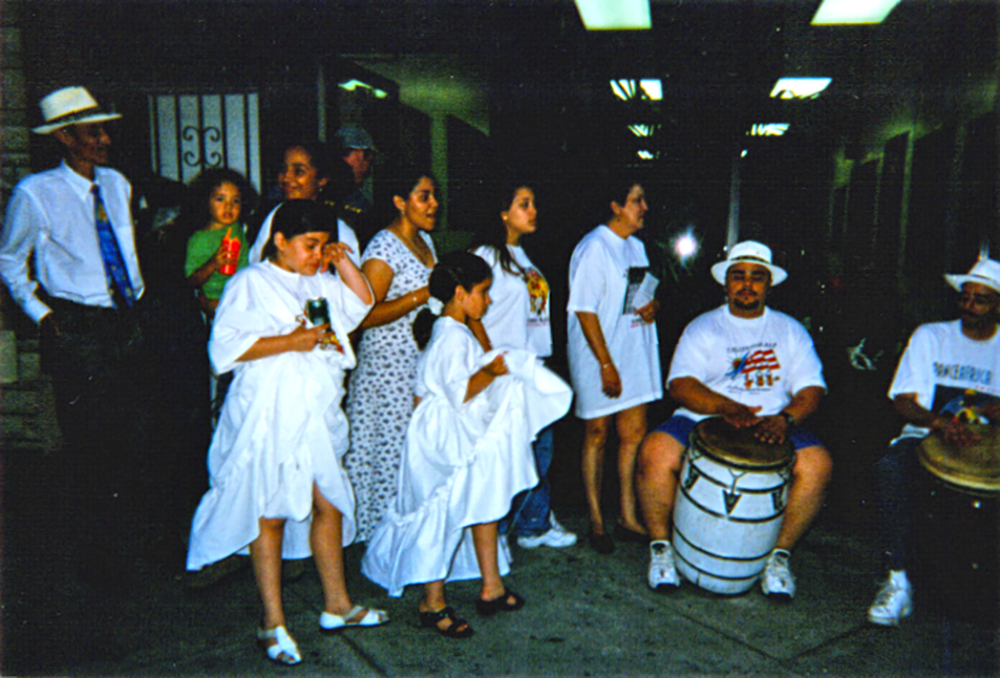
Franklin also arrived—always quiet and modest, yet a brilliant popular theater actor and a constant ally of the barrio’s creative efforts. Tito spotted him from afar and ordered him into the chorus, and Franklin dutifully complied. The women led the singing, and at one point, there were four female singers. These same women would abandon the chorus, borrow a skirt, and ignite the dance with flaring white fabrics.
As night fell, some people left, others arrived, and on the balcony the men began a plena set. Instead of the candid love songs, passionate dances, and centuries-old laments of the women, the men brought plena songs from the last century, filled with risky romances, ghostly apparitions, and celestial protections. By then, the streetlights were flickering over the Division Street Paseo Boricua, the stretch marked by the two largest Puerto Rican flags in the world.
The bitter white neighbor on the third floor didn’t call the police this time. The drumbeats continued calling the people, blending with the noises of passing traffic and the praises from a nearby Pentecostal church. The bomba dance ended early—tomorrow, everyone had to rise early for work.
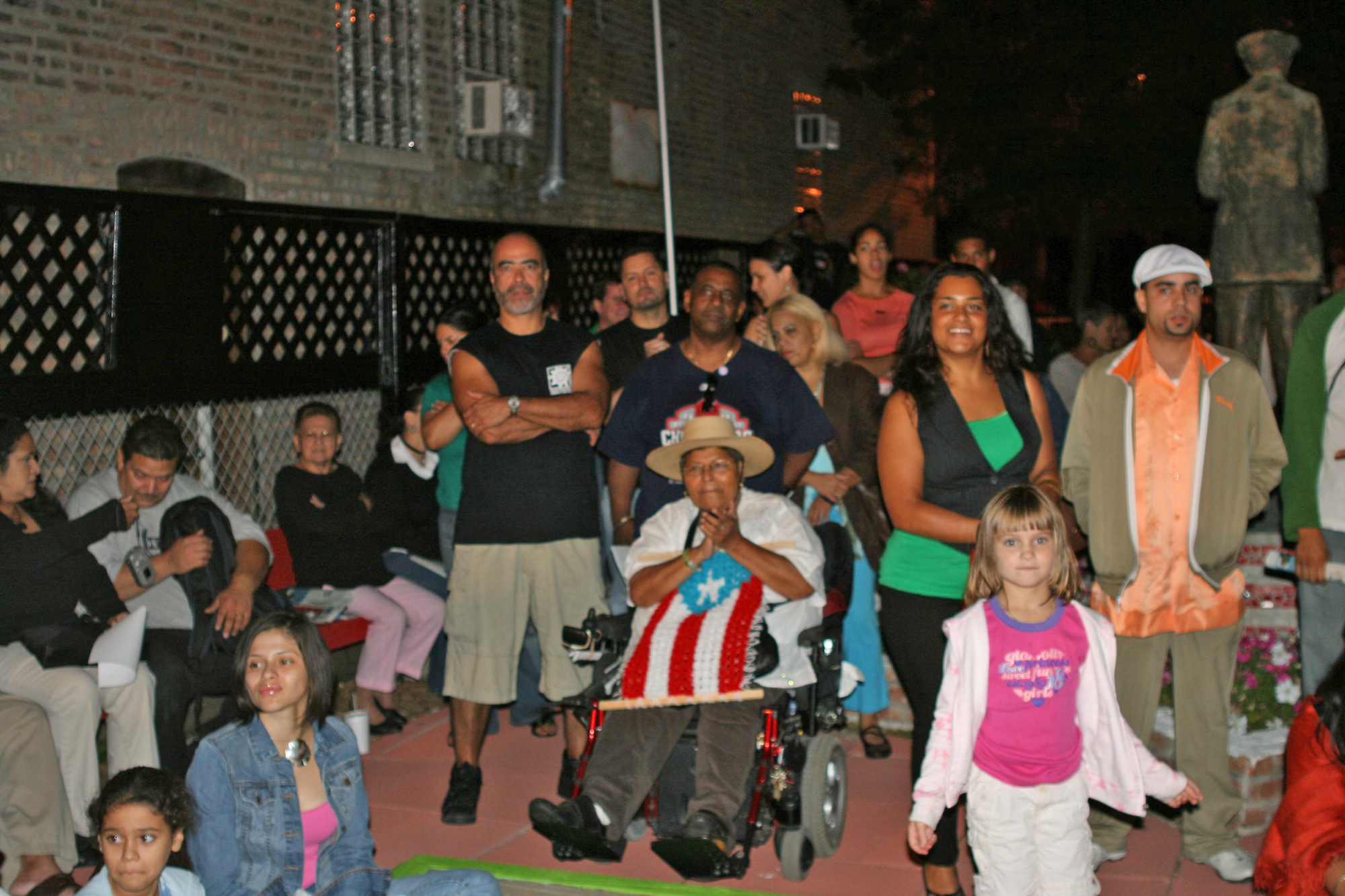
Such is Puerto Rican popular culture in the United States: spontaneous and communal, yet filled with a deliberate struggle to preserve and reinvent memory. This volume explores that effort. Of course, Puerto Rican culture is more than popular culture, but here we limit ourselves to the latter. We do not concern ourselves with the behavior of institutions that produce culture from positions of authority within the complex society of the Puerto Rican diaspora. In other words, we do not examine here the cultural production of academies, corporations, government agencies, churches, or externally funded programs, nor of individuals whose cultural participation springs from the worldviews of such institutions. What interests us is the culture the people make themselves—not the culture imposed or manufactured for them by dominant sectors.
Culture is not a thing but a way of doing things. Popular culture—the way ordinary people do things—does not appear in isolation but is interwoven with all other aspects of general culture. Thus, in a festival celebrating a tradition shared by the people, we find commercial, legal, political, and ideological elements that arise not from the people but from the institutions that organize and control the event. Mass-produced decorations and clothing, music performance contracts, corporate sponsorships, government funds, space-use regulations—these are not part of popular culture. Alongside these institutional components, however, live the people’s own ways of maintaining and transforming shared memory: community-made food and drink, genuine handicrafts, ways of displaying decorations and dress, songs and dances from local artists, and symbolic blends of the sacred and profane—all initiatives born from the people, not top-down impositions.
At the same time, the coexistence of institutional and popular aspects causes them to influence each other. The people’s acceptance or rejection of what is imposed reshapes dominant institutional culture, while innovation and redefinition of public behavior within institutional frameworks provoke adjustments and new popular initiatives. Popular culture, therefore, is transformative and dynamic and is best understood as the movement within the people’s ways of understanding and doing things.
To understand Puerto Rican popular culture in the United States, one must begin with the essential realities of the diaspora. On the one hand, the cultural behavior of the Puerto Rican people is limited by the cultural impositions of a predominantly Anglo-Saxon, racist society whose fundamental relationship with Puerto Ricans is one of colonialism. This means that Puerto Rican popular culture in the U.S. belongs to a subordinated, attacked, and criminalized population—culturally, politically, and economically. In the dilapidated buildings of migrant Puerto Rican workers’ neighborhoods, there were frequent police raids against the illegal yet defiantly maintained cockfights, with roosters meticulously bred in the hidden corners of basements. Even today, the occasional daring cockfighter is arrested, convinced the ban is unjust.
On the other hand, Puerto Rican migration has been overwhelmingly popular—that is, the island’s dominant sectors did not initially accompany the poor who migrated seeking better conditions abroad. This produced two distinct yet complementary consequences: a sense of abandonment in the face of discrimination and exploitation, and a democratization of island cultural expression, freed from the control of Puerto Rico’s dominant class. For example, the first recordings of Puerto Rican music in New York in the 1920s and ’30s were more plena than danzas. Although in recent times we see the rise of cultural steering from the Island and even within the diaspora itself, the initial democratic force has not lost its relevance. Salsa music remains an exercise in democratic creativity. A defining religion among the poor Puerto Ricans of the diaspora is a mixture of spiritism and santería that still lacks a formal name.

Another essential reality is that this culture—attacked and discriminated against by the imperial society and relatively free from the direct control of the Island’s dominant sectors—builds a way of life in proximity and relation to other ethnic minorities with whom it shares common problems despite cultural differences. The striking achievements of street graffiti and hip hop were mestizo processes in which Puerto Ricans played leading roles, alongside youth from other ethnic groups.
All this points to the complexity of our culture in the diaspora. It is not simply about assimilating into a new culture or reaffirming a traditional one. Rather, it is the movement of ways of living where impositions, traditions, influences, discoveries, and reinventions of identity coexist and transform.
Let us return to the bomba dance at the Casita de Don Pedro. The building of casitas in Puerto Rican neighborhoods of some U.S. cities is a cultural response that reinvents a tradition even as it transforms it. This particular casita was once a residential garage, like so many found in the alleyways of Chicago’s neighborhoods. With its four-sloped roof, all it took was adding a tropically designed balcony to create a Puerto Rican casita. Yet the casita requires insulation and windows and doors designed to withstand the brutal winter cold. Bomba dances are confined to the summer months—the season when most public expressions of Puerto Rican culture are concentrated. The children eager to learn how to play and dance understand instructions best in a mix of Spanish, English, and Spanglish. Some come from hybrid families, where Puerto Rican blood mingles with that of other ethnicities. When the bomba ends, the youth drift among salsa, merengue, pop music, and hip hop.
We will not delve deeper into these complexities here. It is enough to acknowledge their presence, which defies simplistic definitions. What matters is that our people insist on loudly announcing their Puerto Ricanness—and the youth are even louder in this than their elders. Here, no one uses the term Puerto Rican-American. First, they are Puerto Ricans; then Latinos; but above all, they love to call themselves Boricuas—and that’s that. Nearly a century of life in this strange land has not been enough to make them abandon their ancestral identity. On the contrary, as I’ve already mentioned, this year, one hardly sees U.S. flags at the Puerto Rican festivals in Chicago, while the Lares flag appears everywhere. Why this fierce insistence on clinging to a complicated but vital Puerto Rican identity?
Here, as always, it is the reader who must finish the text.