Undoing colonial damage and dependency transcends politics
Lola Rosario, Mar 25, 2026
Originally published at The Latino Newsletter

LOÍZA — Puerto Rico is the world’s oldest colony. To be “una colonia” is to be in a constant state of contradiction and disconnect from self, identity, and culture. This separation is directly related to our collective trauma.
However, how often do Puerto Ricans reflect on the resulting psychological impacts?
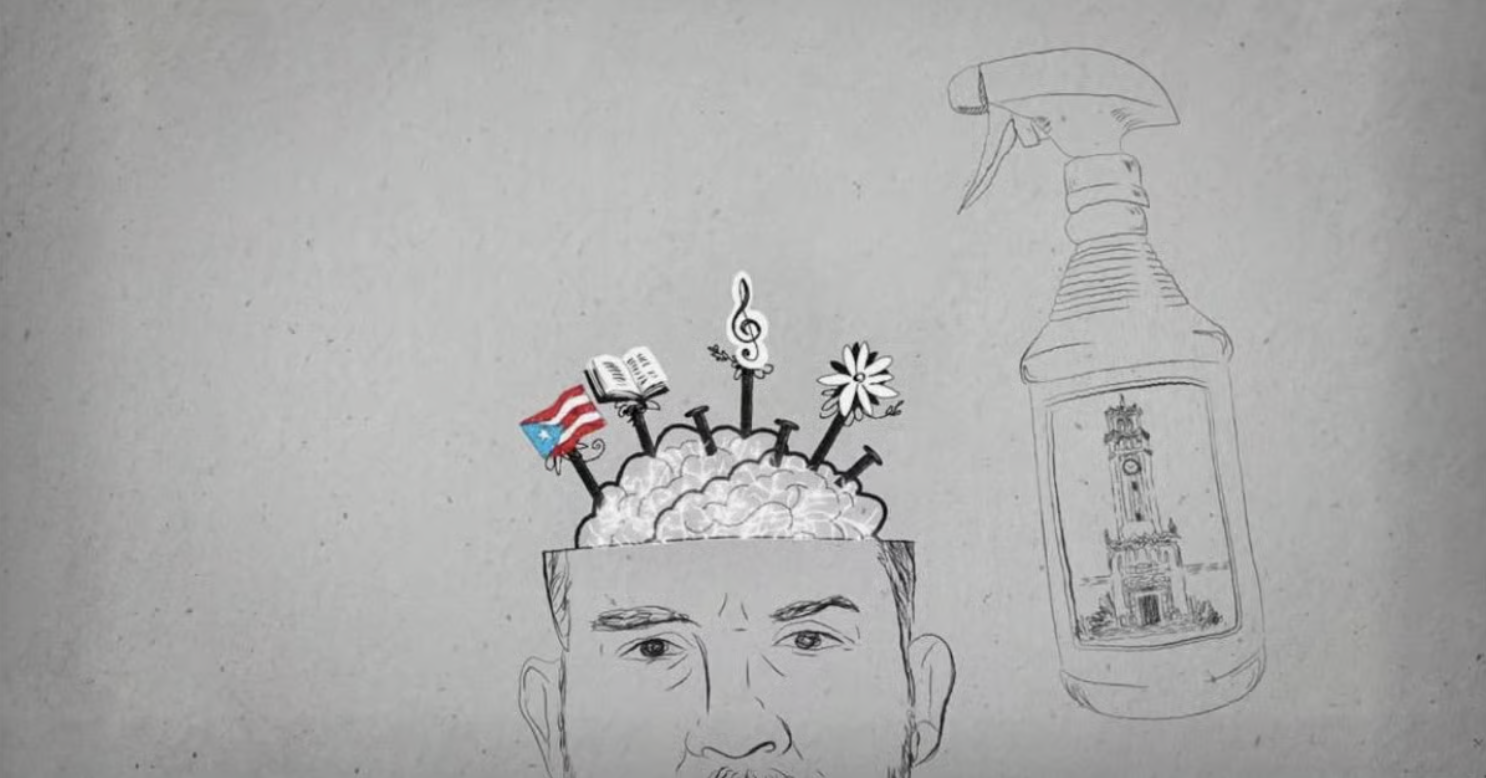
“Psiquis: Un Giro Decolonial” (Psyche: A Decolonial Turn), a 2024 documentary by independent filmmaker Tito Román Rivera, forces viewers to contend with what the colonial relationship has done to our psyche. Drawing on the work of Martinican anti-colonial scholar Frantz Fanon, the film shows how Puerto Ricans can rewire their brains away from a colonial mentality and towards one of critical thought.
“Psiquis” urges us to nurture critical thinking as a path towards individual and collective liberation, instead of relying on what has been inculcated in us by the colonial systems we live under.
In the film’s opening scene, Román Rivera — who was raised in San Juan’s Manuel A. Pérez residential housing complex — asks his childhood friend why people have started saying that he was being brainwashed at the University of Puerto Rico.
“You started changing your vocabulary, your way of being. You used to like being with us all out of control, out on the streets. Then, you started with the seriousness, the vocabulary and the ideas, a lot of ideas. You started talking about culture, about things that we’re not used to talking about in the neighborhood because we’re not educated to do that,” his friend David Rodríguez Viera says.
Many Puerto Ricans have faced similar experiences in their lives. In Puerto Rico’s colonial context, brainwashing has taken multiple forms. For example, the myth that we are a “mix of three races” to deny racism exists here, or saying that the best political status option is to become the 51st state, even criminalizing the pro-independence struggle. There’s a breadth of learned behaviors, like toxic masculinity and prioritizing Anglo traditions, that confuse our national identity, causing conflicted allegiances and perpetuated patriarchy, the socio-cultural and political system where authority is primarily held by men.
For the documentarian, a cultural guardian who advocates for the preservation of cultural traditions, unlearning these traditions is achievable. “Psiquis” emphasizes neuroplasticity, the brain’s capacity to adapt to new information and experiences, as a way to replace “the colonial garbage imposed on us since birth with new information by rescuing our true history.” Román Rivera’s experience at university was crucial to this process.
“They tell you, ‘they are brainwashing you at university,’ which means they messed with it during elementary, middle, and high school. There is a recognition that something is wrong. We proposed opening ‘Psiquis’ with a process of healing and cleansing our mentality, our brain,” Román Rivera told The Latino Newsletter.

Facing Fear Through Ancestral Connection
“Colonialism is violence. Our ancestors were subjected to violence, so violence has been part of our history from the beginning,” says Dr. Iris Zavala-Martínez, a Puerto Rican feminist, academic, and clinical psychologist, in Psiquis.
From our indigenous Taíno heritage to our African ancestors, Puerto Ricans descend from a lineage of persecution that presents itself as intergenerational trauma. This pattern manifests throughout our history in many ways, including population displacement, the imposition of a non-elected Financial Oversight Board in 2016, and Senate Bill 273, which proposed the dismantling of the Institute of Puerto Rican Culture.
“Colonialism has stripped us of our sense of belonging to the land where we were born, to what truly represents our grandparents, our great-grandparents, our great-great-grandparents. In other words, once that umbilical cord, that connection, is cut, once it’s disconnected, you’re lost,” Román Rivera explained.
“When you begin to understand that the situation in our country, living under a colonialism that is criminal against the existence of our nation, that it attacks the very guarantee that our people can or cannot continue to exist, then we enter into a realm that has to do with our connection to our ancestors,” he added.
By instilling fear and making us forget our history, the colonial government and the patriarchy can exert control over our lives. From education to the health system, this control extends beyond politics. Ours is also a spiritual struggle, Román Rivera reminds us.
“When viewed from this lens, the struggle takes on other dimensions, fear is transformed as well,” he said.
An Overdue Healing
Wounds take time to heal. La Isla del Encanto has been healing for centuries.
“Imperialism leaves behind germs of rot which we must clinically detect and remove not only from our land but from our minds as well,” Fanon wrote of imperialism.
“Psiquis” serves as a reflection point, a catalyst for us to become proactive participants in our recovery through critical thought.
We are ready. Puerto Rico’s decolonial turn has accelerated since the 2019 ouster of former Governor Ricardo “Ricky” Rosselló and the historic 2024 elections, where the Independence Party reached second place for the first time in seven decades.
“Psiquis,” alongside organizations like NeuroBoricuas, is teaching about neuroscience as a form of empowerment. Meanwhile, other cultural guardians, like poet Solimar Ortiz Jusino, and the archival storytelling project, ¡Loíza Vive!, are building movements and projects that are shaping the Republic awaiting us on the other side — because only liberation can truly heal us.
About the Author
Lola Rosario is a Nuyorican spoken word poet and freelance journalist living in Loíza, Puerto Rico.