
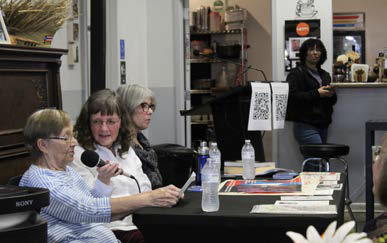
Digitizing El Barrio hosts a panel of local women activists to reflect on the history of anticolonial activism and political repression in Humboldt Park and West Town during the 1970s–1990s. Dr. Michael Rodriguez Muñiz and Angelica Hernández, Director of Digitizing El Barrio, welcomed guests and introduced the panel which coincides with their initiative in preserving the history of Chicago’s Puerto Rican community. The event was located at ¡Wepa! Mercado del Pueblo on a balmy Saturday afternoon on Nov. 15th, guests filled the room with extra chairs required to accommodate such a large turnout.
Moderated by José E. López, Executive Director of the Puerto Rican Cultural Center, below are short bios of each activist and some excerpts from their answers: Maritza Nazario is an artist and educator from Puerto Rico who came to Chicago to pursue graduate studies. Her introduction to activism started during her first year attending the University of Puerto Rico in 1975. She volunteered to be a part of a human chain during her first strike which resulted in a broken nose.
However that did not deter her, she would later continue the work and collaborations including joining the “Partido Socialista” (Puerto Rican Socialist) party. In Chicago, she became an instructor at Dr. Pedro Albizu Campos High School (PACHS) and Roberto Clemente High School (RCCA). At RCCA, she developed a cultural program that engaged youth on aspects of Puerto Rican culture, which many of them would skip lunch to attend. López says it was during this time that Nazario was targeted by the FBI on the narrative that it was a training ground for terrorism, for FALN (Fuerzas Amadas de Liberacion Nacional Puertorriqueña). “When the investigation came, it was the worst part, because they took the problem away. Even though I was assigned to implement them, and I had my certification of bilingual education and arts. They took me out of there. They first changed the students. Took all my Latino students and changed them for the Vietnamese students, which I had nothing. They had nothing to do with that. So I had them singing and dancing and acting, and they loved it. They loved it. They learned English like that. And eventually they thought that I was, I guess, doing a decent job with the Vietnamese too. So they took that away from me, too, and they put me in appreciation of music, which I didn’t have a license for..” “I left Clemente and I left the country. What did they do? Well, among the many things they did, they intervened my phone. They showed up at my house. They park in front of my house every day. They will follow me everywhere I go. They will call me in the middle of the night. They broke into my house. They almost killed my dog. Of course, they said it wasn’t them, but we know it was them. They are. Told me that if I didn’t cooperate with them that they were gonna take my children away, and my children, those were my children. And I just kept going. I said, Whatever you have next for me, bring it on.” “This is the first time I tell this story…when I came into this trouble, I came as me. I was no leader. I didn’t have followers. I was just a person, a person who realized at an early age of 18 where my principles were… It wasn’t because I was afraid to
talk about it, or because I was hiding, or because I didn’t want people to think anything. It was because it was my story. And I know that the day will come and I will share my story, and I’m so glad that it’s here today.”
Margaret Power is a history professor with a focus on Latin America, women and gender. She grew up in southwest Pennsylvania in a small town during a time of anti-war, anti-Vietnam War movement. As a half-Australian, she went to high school there and it was when she came back to the U.S that she started her activism within the anti-war movement. It was after joining the Prairie Fire Organizing Committee that worked on the Puerto Rico solidarity movement. “We were pariahs on the left. Nobody wanted to have anything to do with us, because we were associated with the FALN, and therefore they thought ‘Danger’… That’s what we represented.
So a lot of our work was to go out there and try to talk to people about Puerto Rico that it’s a colony. And second, that people needed to support the independent movement. And third, people needed to support the political prisoners. And you get all this push back that ‘They’re not prisoners of war’, ‘There’s not a war’ Or, you know, all the stuff. So we spent a lot of time, and some of the things we did was wheat pasting.”
(see photo)
Alejandrina Torres is a former political prisoner, convicted for involvement with FALN, spending 16 years in prison. She was born in Puerto Rico and at age 10 traveled to New York, in 1930. She later moved to Chicago to live with her sister and work for the Cook Country Department of Health. In 1964 she married into the Torres family, and it was around that time she became involved with activism within the Humboldt Park community as a result of the 1966 riots.
“(The riots) came about as a result of police. Puerto Ricans were celebrating the first Puerto Rican Day Parade in Chicago. It was a time of pride, a time of turmoil, and by resulting the death of someone in the community. We continue working in the community as a result of the displacement of its residents, a bureaucrat who was insensitive to the needs of the community and its residents. At the time, mostly for the weekend, we struggled for inclusion of different available services, but also felt the need to create alternatives.” “I am proud of what I’ve done, to control our humanity…I’m not just talking about myself but all the prisoners that were there. The only thing they could not destroy was our spirit and we’re still here and we will continue the story.”
To stay updated with Digitizing El Barrio or if anyone would like to share their personal memories and stories during 1970s-1990s in Humboldt Park or West Town, contact the lead archivist [email protected] or visit their social media @digitizingelbarrio