
By Dr. Maura Toro-Morn
The following story by Dr. Maura Toro-Morn, professor of sociology and director of the Latin American and Latino Studies program, reflects on her term as president of the Puerto Rican Studies Association.
In the world of college professors, teaching, research, and service are three dimensions that anchor our professional and academic responsibilities. These are not neatly divided areas. In fact, there is a lot of overlap. For example, we attend professional meetings to share our research, and we also become members of these organizations. Many of these organizations are also run through the volunteer work of faculty elected to executive positions. These positions carry a lot of prestige for the university, as we position ourselves at the forefront of constitutive conversations in our fields of inquiry that inform both our research and teaching.
For the last two years (2024-26), I served as president of the Puerto Rican Studies Association (PRSA), one of the oldest interdisciplinary academic associations dedicated to advancing scholarship, research, and teaching centered on Puerto Rico, Puerto Ricans, and the diaspora.
Founded in the 1990s, the PRSA seeks to foster dialogue and collaboration across disciplines and institutions to enrich the field of Puerto Rican studies. For decades, we have nurtured generations of scholars (myself included), creating a vibrant intellectual and activist community. Through our biennial conferences, online presence, and virtual programming, we provide spaces for dialogue and cross-disciplinary collaboration to further the field. The organization’s ongoing commitment to recognizing excellence can be seen in the two awards it offers: the Frank Bonilla Book Award and the Virginia Sánchez-Korrol Dissertation Award. To see the the 2026 winners, visit RicanStudies.com.
I started my term in 2024 as vice president/presiden elect and will complete this journey in December 2026. There were many memorable moments during my tenure, but the most significant was organizing the biennial meeting, held September 11-13, 2026, at the University of Illinois Chicago, a university with a long history of commitment to the organization. As I pointed out in my welcome speech on the morning of Friday, September 11, several executive board members hail from the University of Illinois system. Now Illinois State University has added a new chapter to the history of the organization, as I am the first (maybe only one) PRSA president from Illinois State!
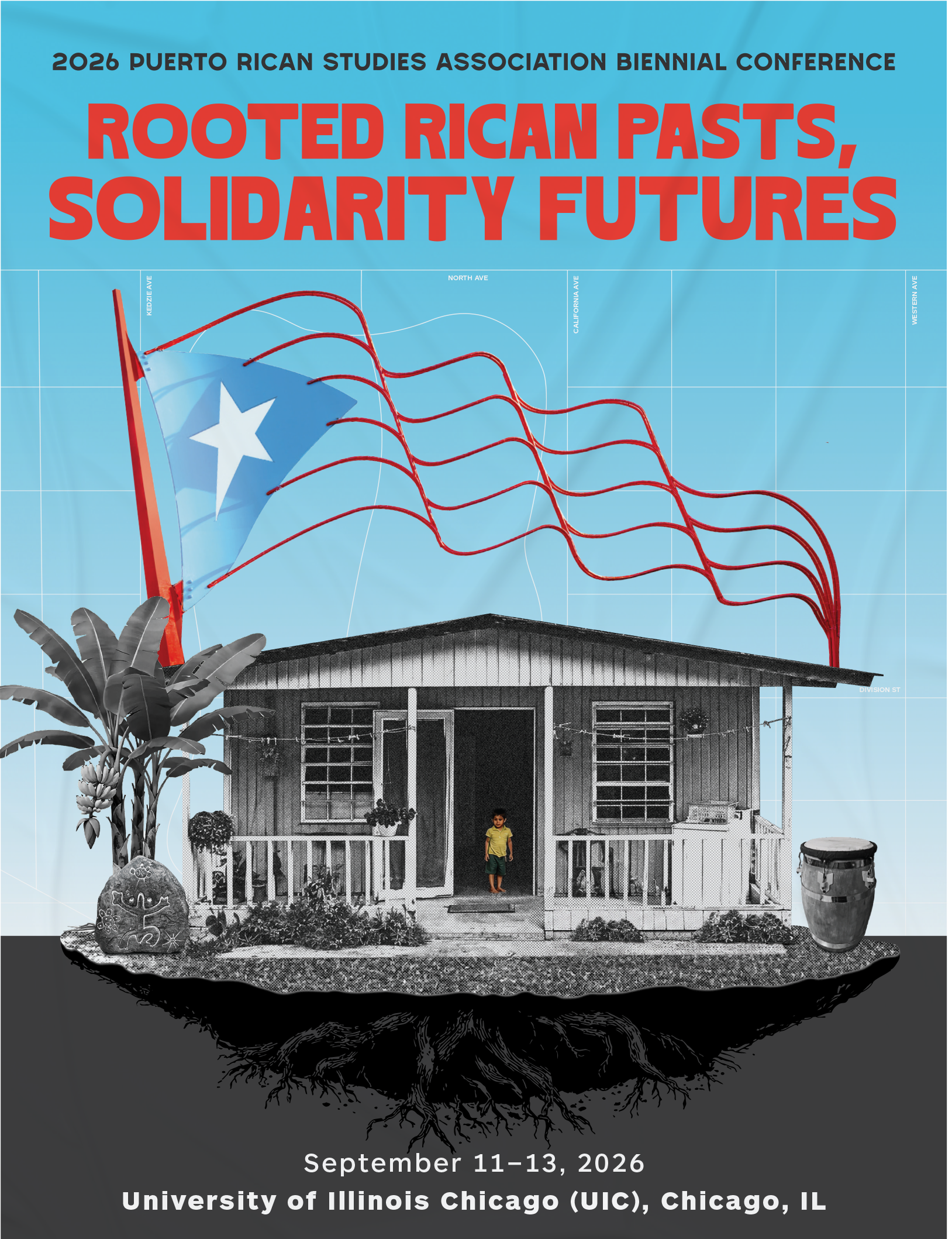
The theme of the meeting, “Rooted Rican Pasts, Solidarity Futures,” invited presenters to share the histories that shaped Puerto Rican experiences across the diaspora and the complexities of the current moment. We also wanted them to imagine futures shaped by collective and radical struggles and transformative solidarities. In my own scholarly work, I have worked hard to place Chicago as central to the study of the Puerto Rican diaspora thus my desire to host the conference here to showcase that history.

For me, Puerto Rican Chicago’s story is inseparable from our conference theme. The towering steel Puerto Rican flags and the murals along Division Street stand as symbols of our determination to plant roots and of the solidarity that has sustained our collective efforts to resist displacement and gentrification. It was on Division Street that Puerto Rican Chicago first made itself impossible to ignore. On June 12, 1966, when a police officer shot and wounded Aracelis Cruz, the neighborhood erupted into three days of unrest that changed how Puerto Ricans understood themselves and their place in the city. From that struggle emerged a community committed to self-determination. Residents organized to demand better housing, schools, healthcare, and political representation.
Further, the history of Puerto Rican Chicago is one of transforming displacement into collective action and marginalization into political voice. The Young Lords, the Juan Antonio Corretjer Puerto Rican Cultural Center, the Puerto Rican Arts Alliance, the Segundo Ruiz Belvis Cultural Center, La Escuelita Bombera de Corazón, El Schomburg, and the recently nationally accredited National Museum of Puerto Rican Arts and Culture represent only a small sample of this enduring legacy of resistance, solidarity, and community building. In those spaces we shared our stories, affirmed nuestra cultura, and asserted our humanity.
The heart of the community, once known as Paseo Boricua and now called Barrio Boriken, is one of the nation’s most visible Puerto Rican cultural, economic, and political districts in the diaspora. Its new name reflects a broader vision to preserve and strengthen the community’s presence, cultural institutions, festivals, and public art for future generations. What was even more significant for me what the number of Puerto Rican community organizations that supported the conference.
The National Museum of Puerto Rican Arts and culture hosted a poetry and spoken word event that internationally known Puerto Rican painter, Maestro Antonio Martorell, Chicago’s poet laureate, Mayda Alexandra del Valle and local poets Eduardo Arocho, and Don Raúl Colon. The same evening, Dr. Cristina Paccione-Zayas, chief of staff for Mayor Brandon Johnson, read a proclamation from the mayor. Our conference honored our theme: Rooted Rican Pasts, Solidarity Futures.
The poetry reading was followed with music by Los Pleneros del Callejón, a music group from Puerto Rico, and yummy Puerto Rican food. The evening was an amazing cultural experience for conference attendees. On Saturday, after a long day of paper sessions and meetings, we gathered at the Casita de Don Pedro and Dona Lolita on Division Street, the heart of the Puerto Rican community, under the guidance of Melanie Maldonado, executive director of Puerto Rican Organization for the Performing Arts (PROPA), to place a plaque, the first in the diaspora, honoring the enduring Afro-Puerto Rican history in the city sustained by African music, such as bomba. In Chicago, community groups have organized to reproduce bomba music to both sustain and reproduce cultural practices connected to Black Puerto Ricans.
Our conference fell on the 10th anniversary of PROMESA (the Puerto Rico Oversight, Management, and Economic Stability Act), which created the Financial Oversight and Management Board (FOMB), also known as La Junta. For 10 years, the people of Puerto Rico have been subject to austerity measures that have crushed our families and communities and pushed record numbers to migrate to old destinations and to new ones, like Florida and Texas. The impact on education, both K–12 and higher education, has been severe: budgets cut, schools closed, and the University of Puerto Rico defunded and under attack.
In fact, one reason I am so proud of this conference is the record number of University of Puerto Rico students and faculty who traveled from our beloved archipelago to be in community with us in Chicago. Many came to share work documenting the impact of these policies on the ground, as well as resistance and opposition to them. Another hallmark of the Chicago conference was the community activists who came from other parts of the diaspora and the archipelago to build community and resistance.
We came together for three days and made history. Scholars, students, artists, and community members shared their work and connected in a space that helped us carry Puerto Rican Studies forward. The conference was a space of conversation, celebration, and communion with the local Puerto Rican community.
This meeting was an important one in the history of the organization, with over 300 people in attendance and over 90 panels in two and a half days. The day before the conference started, we held a workshop for graduate students, pairing each attendee with a faculty mentor to help them develop an article for publication.
All in all, this was a profoundly important moment for me as a Puerto Rican scholar who has built her academic life at Illinois State University, and a moment of pride in showcasing all that we have done and the possibilities that lie ahead. As I shared with attendees in my presidential address, Puerto Rican Studies has been my intellectual home all these years. I attended the first biennial in Puerto Rico alongside a group of young scholars starting their careers, and we grew as intellectuals alongside the organization. PRSA meetings gave us the opportunity to develop collaborative groups.
Now, it is our turn to return the favor by doing the same for the young scholars coming up through the ranks. I am most proud of the number of Illinois State staff and students who also contributed and participated in this conference. They included Dr. Armen Alvarez (University College), Paige Hofstetter (political science/sociology major, class of 2026), Dr. Lourdes Concepcion-Pagan (member of the PRSA board), and Taina Torres, current graduate student in the history department and Latin American and Latino Studies program.
I cannot conclude this piece without praising the work of Kiki Rosado, graphic designer of the conference poster. She worked with the board to put in pictures the theme of the conference: Rooted Rican pasts, solidarity futures.
In closing, Puerto Rican Chicago curator and writer Neyda Martinez wrote, “Chicago carries the heartbeat of Puerto Rico.” For four days, that heartbeat sustained, guided, and affirmed our work. I am immensely proud of this accomplishment, and I will carry the memories and accomplishments of this conference for the rest of my life.
This article orginally appeared in the Illinois State University news.